What happens when a familiar idea encounters an unfamiliar context?
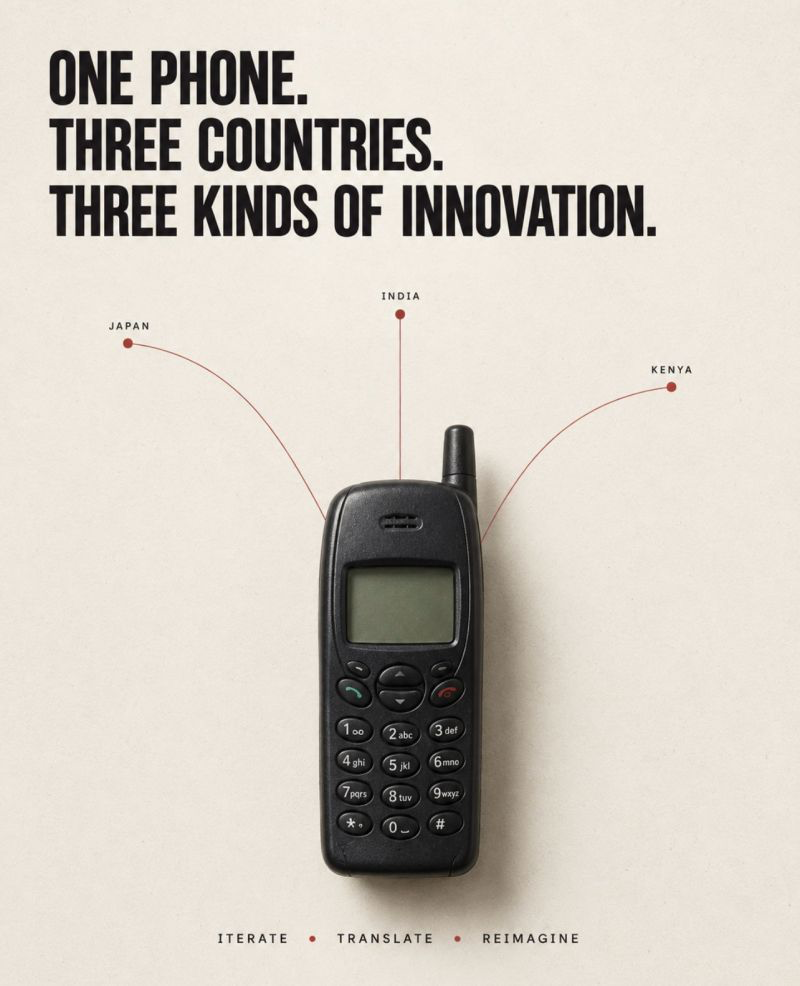
A mobile phone seems to have an obvious purpose: helping people communicate at a distance. Yet people in different places have found very different possibilities inside it. Some improved what it could do. Others changed how it was used. Still others built a new service around it.
Japan, India, and Kenya offer three windows into that process. These are different developments around a shared technology, rather than a single invention passing through the countries in sequence. Together, they show how much innovation can happen when an idea meets local needs.
Japan: iterate
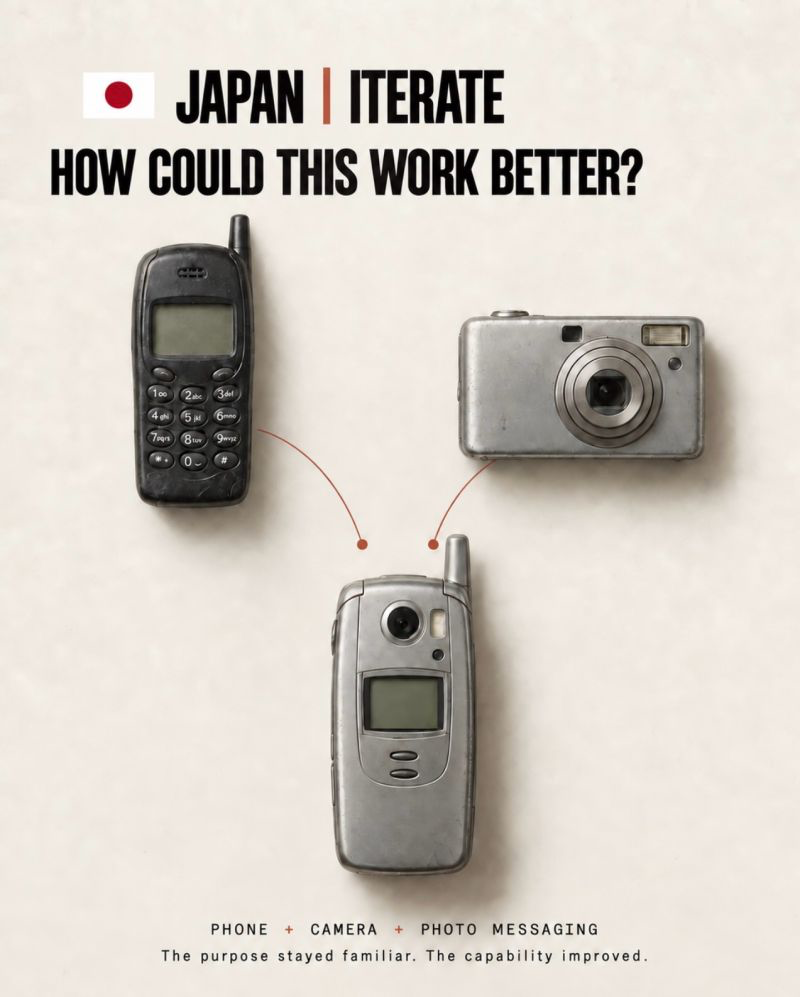
How could this work better?
In 2000, Sharp’s J-SH04, sold by J-Phone in Japan, brought a camera and photo sharing into a mobile handset. Users could take a picture and send it by email from the phone. It was an important early step in making visual communication part of everyday mobile life. Sharp’s product history describes the launch.
The familiar objective, sharing an experience with someone elsewhere, gained a new mechanism. Instead of describing what you were seeing, you could show it. The improvement came from bringing capabilities together in a form people could carry and use.
That is the question behind iteration: what could make an existing idea more useful? A better product can emerge by reducing a step, combining functions, or making an established task easier.
India: translate
How could this work here?
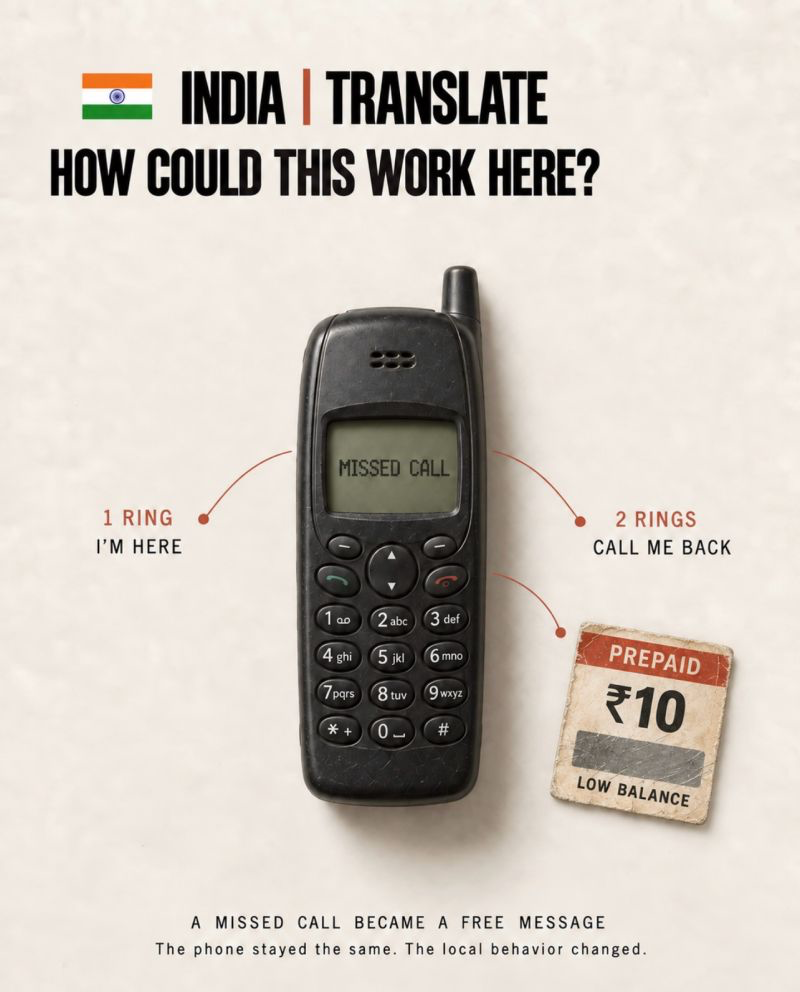
Where the cost of an outgoing call mattered, users found value in a call that was never answered. In India, intentionally leaving a missed call became a way to signal something without paying for a completed conversation. Microsoft’s account of the development of 99DOTS describes this established practice and how it inspired another application.
Between people who understood the context, a missed call could mean “I arrived,” “I’m thinking of you,” or “Please call me back.” The meaning depended on their relationship and prior agreement. The one-ring and two-ring examples in the illustration are possible conventions, not a standardized code across India.
The phone’s hardware did not need to change. People gave its existing signaling function a new local meaning. Similar practices have been documented elsewhere, including in Jonathan Donner’s research on intentional missed calls.
Translation, in this sense, goes beyond language. It means understanding what an idea can do within a different economic and social reality. Sometimes users have already discovered the adaptation before a company notices it.
Kenya: reimagine
What else could this become?
In 2007, Safaricom and Vodafone launched M-Pesa in Kenya. It enabled people to send money using basic mobile phones, opening a way to transfer value without a conventional bank account. The service grew around electronic balances and a network of agents who connected cash with mobile money. Vodafone’s history traces the service’s development.
Here, the phone became an interface for a different objective: moving money. Calling it “a bank in your pocket” captures the shift in everyday possibility, but the handset alone did not create it. A working service required software, trusted agents, reliable operations, and an enabling institutional setting.
Reimagining asks what else familiar capabilities could support. A device that connects people might also connect them to payments, health services, or new forms of work. The opportunity lies in the relationship between the capability and the unmet need.
Three questions, one habit of attention
Iterate, translate, and reimagine are useful lenses, not rigid categories or a required sequence. One innovation can involve all three. Their value is in helping us notice what is changing: the capability, the way people use it, or the purpose it serves.
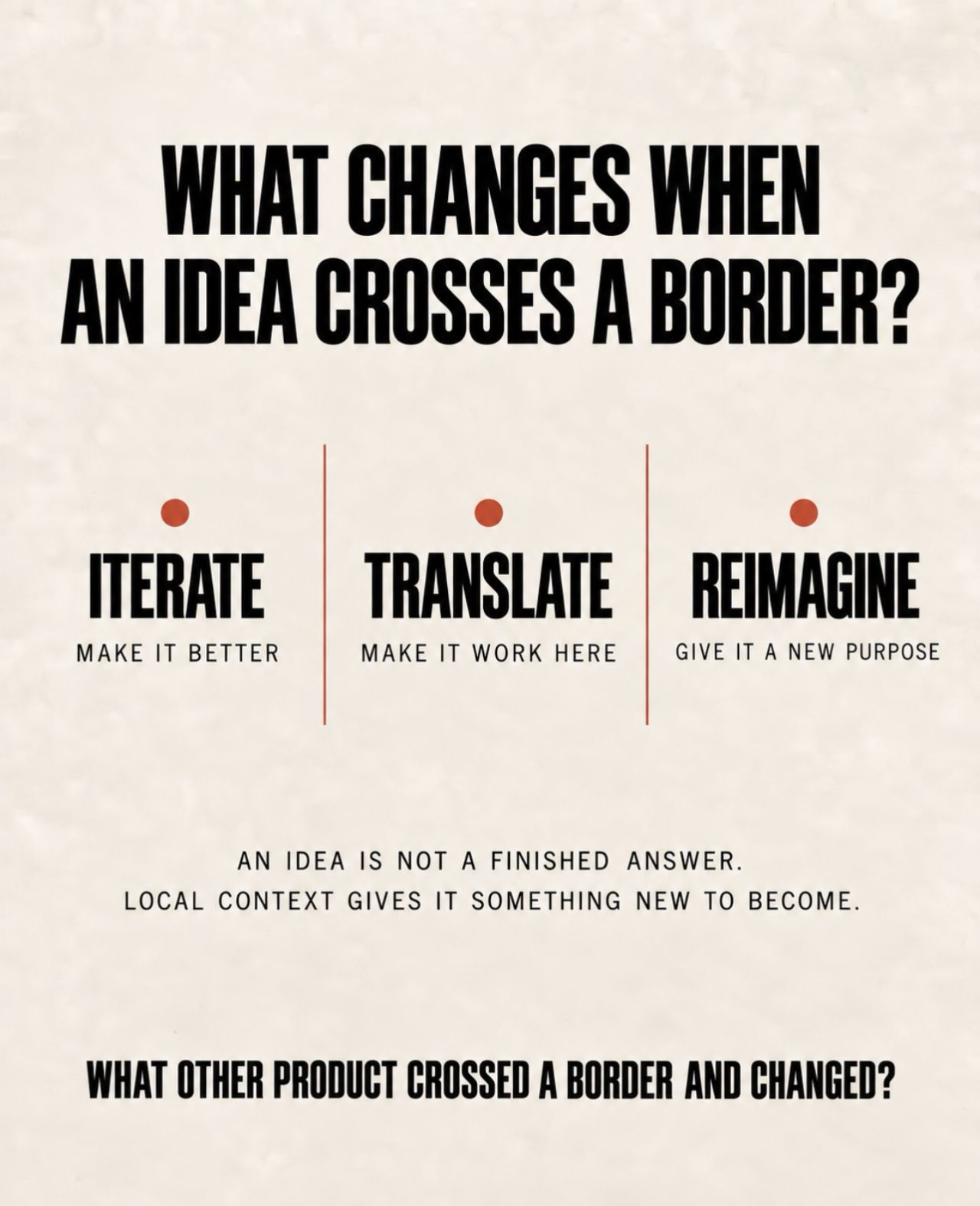
Our Objective, Mechanism, and Conditions lens helps make those changes explicit. What result are people seeking? How does the idea produce it? What has to be true for that mechanism to achieve that objective?
A camera phone needs more than a lens. A missed-call message needs shared understanding. A mobile-money service needs more than connectivity. In each case, the conditions help explain why the idea works and what another place would need to examine.
At Localize This Idea™, we start with what works elsewhere and ask what we can learn from it. Through Co-Fox™, we aim to help people practice looking beneath the product, questioning assumptions, and choosing a useful next step.
Try it with an idea you know
What could change when this idea meets a different place?
Choose one familiar product or service. Ask how it could work better, how it could work locally, and what else it could become. Then identify one condition you would need to investigate before acting.
How do you think across borders? Take the quiz ↗