
We admire people who can see a connection between things everyone else keeps separate.
A polymath draws on knowledge across multiple fields. An insight from biology might illuminate an engineering problem; a principle from music might suggest a different way to think about mathematics. The ability to connect those worlds can make an overlooked possibility visible.
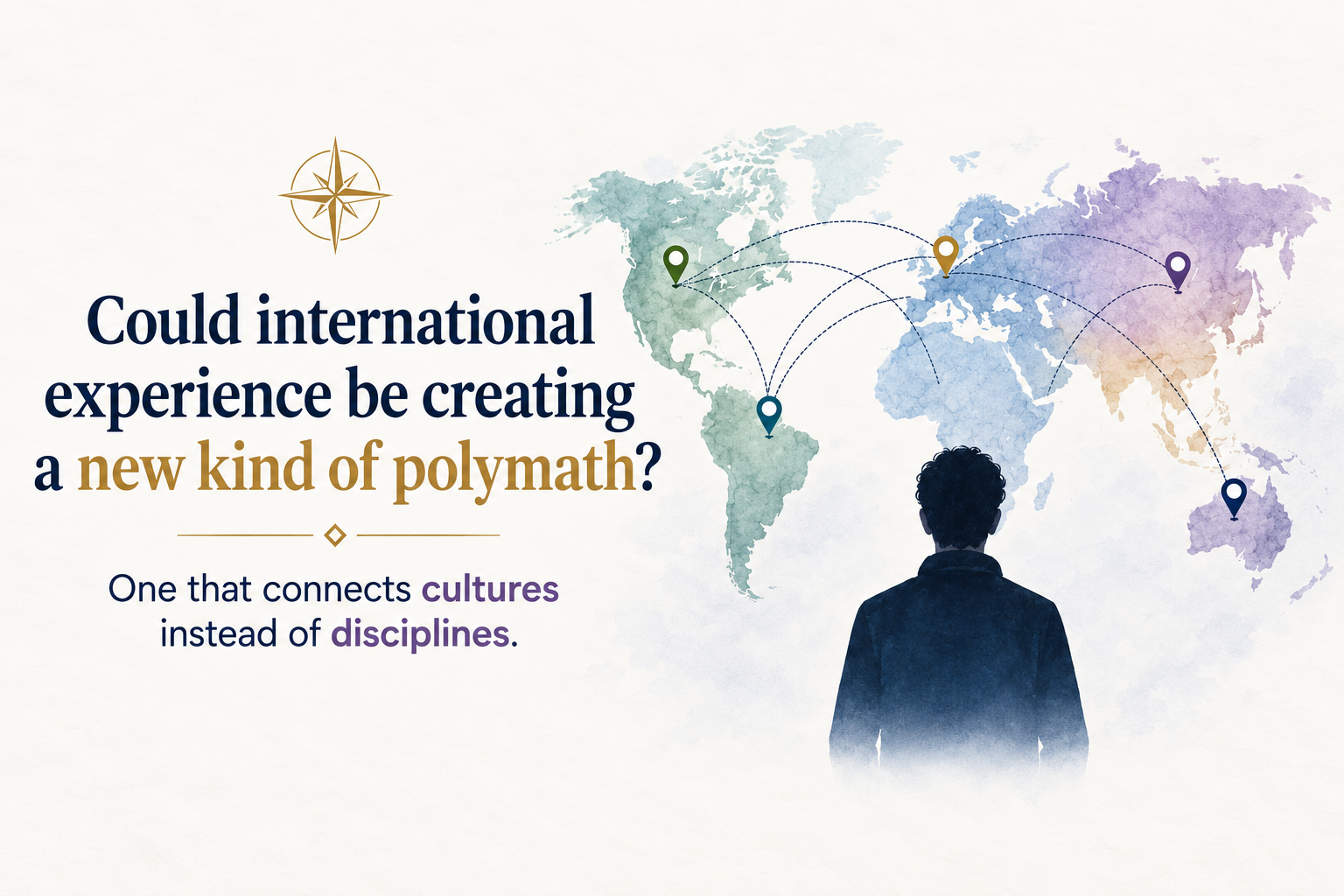
What if deep engagement across borders could develop a related habit of mind? Someone working between Colombia and Canada may learn to compare how an idea behaves in different markets, institutions, and communities. Their range comes partly from learning more contexts.
Two ways to make connections
“Cross-border polymath” is a useful metaphor for this capability, rather than an established scientific category. It describes someone who develops depth in understanding different contexts and learns to translate between them. That capability can complement specialist expertise and knowledge across disciplines.
Across disciplines
Connect concepts from different fields, compare their methods, and explore whether knowledge from one subject can help explain another.
Across contexts
Compare how people solve similar problems under different cultural, commercial, and institutional conditions, then investigate what could transfer.
The same person can develop both abilities. Neither depends on knowing a little about everything. The value comes from understanding enough to make a meaningful connection, and recognizing when a specialist or local partner knows something essential that you do not.
A new context makes assumptions visible
When an approach works at home, it is easy to mistake familiar conditions for universal ones. A reliable delivery network, an accepted payment method, or a particular way of establishing trust may fade into the background. In a new setting, those assumptions become questions.
Imagine a business taking a subscription service into another market. The objective might remain dependable access to a useful product. But automatic billing, delivery frequency, and the way customers commit could all need reconsideration. Local customers and operating conditions shape the approach.
Comparing the two settings becomes a mental experiment. Which part of the approach creates value? Which part relies on conditions that may no longer hold? A promising pattern is a hypothesis to examine, not proof that the same result will follow.
Experience matters when it becomes learning
Research offers some support for the connection between cultural adaptation and creative thinking. In a 2009 study by William Maddux and Adam Galinsky, experience living abroad was associated with creativity, and adaptation to another culture helped explain that relationship.
As the American Psychological Association’s summary notes, the findings do not establish that living abroad itself causes greater creativity. They also do not show that every internationally experienced person becomes a better innovator. The useful distinction is between encountering difference and doing the work of understanding it.
That work involves listening, questioning your first explanation, and learning why a practice makes sense to the people who use it. A country is never a single context. Experiences can differ sharply between regions, industries, organizations, and communities within the same border.
Translate with people who know the place
Pattern recognition becomes more useful when it is paired with local knowledge. Someone arriving from elsewhere may notice an unfamiliar possibility. Someone rooted in the community may immediately recognize the missing relationship, practical constraint, or cultural meaning that determines whether it can work.
Together, they can ask better questions. What are customers actually trying to achieve? Which alternatives do they already trust? What resources are available, and who controls access to them? How would the proposal affect the people expected to participate?
Cross-border thinking is strongest when it creates this exchange. It should deepen respect for local expertise and make collaboration more productive.
A habit you can practice
You can begin by comparing two settings around one concrete problem. Describe each on its own terms before deciding what they have in common. At Localize This Idea™, we use three questions to make that comparison more precise:
- Objective
- What result matters to the people involved?
- Mechanism
- How does the approach produce that result?
- Conditions
- What has to be true for that mechanism to achieve the objective?
Then identify one assumption that changes between the settings and find a small, practical way to investigate it. A conversation, observation, or limited trial can help distinguish an attractive analogy from a useful opportunity.
This practice can begin close to home, through collaboration across communities, sectors, or cultural backgrounds. International experience offers rich opportunities for comparison, but curiosity and disciplined learning are habits people can cultivate in many settings.
A question to take with you
What have you seen work elsewhere that your community approaches differently?
Before proposing a transfer, ask someone in each setting why their approach makes sense. Look for the shared objective and the conditions that explain the differences.
Learn to see beyond the familiar
Perhaps one of the most valuable capabilities we can develop is the ability to recognize useful patterns across contexts while respecting their differences. It combines curiosity with judgment, and the confidence to explore with the humility to revise an assumption.
The opportunity is to become someone who can see beyond the borders of their own experience, learn from what works elsewhere, and help shape it into something meaningful here.
Continue exploring
Your next breakthrough may already exist somewhere else explores how organizations can put this habit into practice.